What Guns Do Marines Use? Main Weapons Explained
If you are asking what guns do Marines use, the short answer is that it depends on the job. Most Marines are trained around the service rifle, while others use pistols, machine guns, shotguns, and specialized weapons for their assignment.
The Marine Corps does not hand every Marine the same weapon for every mission. A rifleman, machine-gunner, military police Marine, and sniper all use different tools, even though they all train to handle firearms safely and effectively.
That is why the best way to answer this question is to break the weapons down by role. You will see the main guns, what they are used for, and how they fit into Marine training.
Before any handling, remember the core safety rules: treat every gun as loaded, point the muzzle in a safe direction, keep your finger off the trigger, and unload and verify before cleaning or maintenance.
Keep reading for a clear, practical breakdown of the weapons Marines commonly use.
Key Takeaways
- The Marine Corps uses different guns for different jobs, not one universal weapon for every Marine.
- The standard Marine fighting rifle is commonly the M4 carbine or M27 Infantry Automatic Rifle, depending on the unit and role.
- Many Marines also train on pistols such as the M18, and some units still use older sidearms in limited roles.
- Support weapons include the M240 machine gun, M249 squad automatic weapon, shotguns, and other mission-specific firearms.
- If you want the exact current issue weapons for a specific job or unit, confirm with official Marine Corps sources because equipment can change.
Start With the Service Rifle
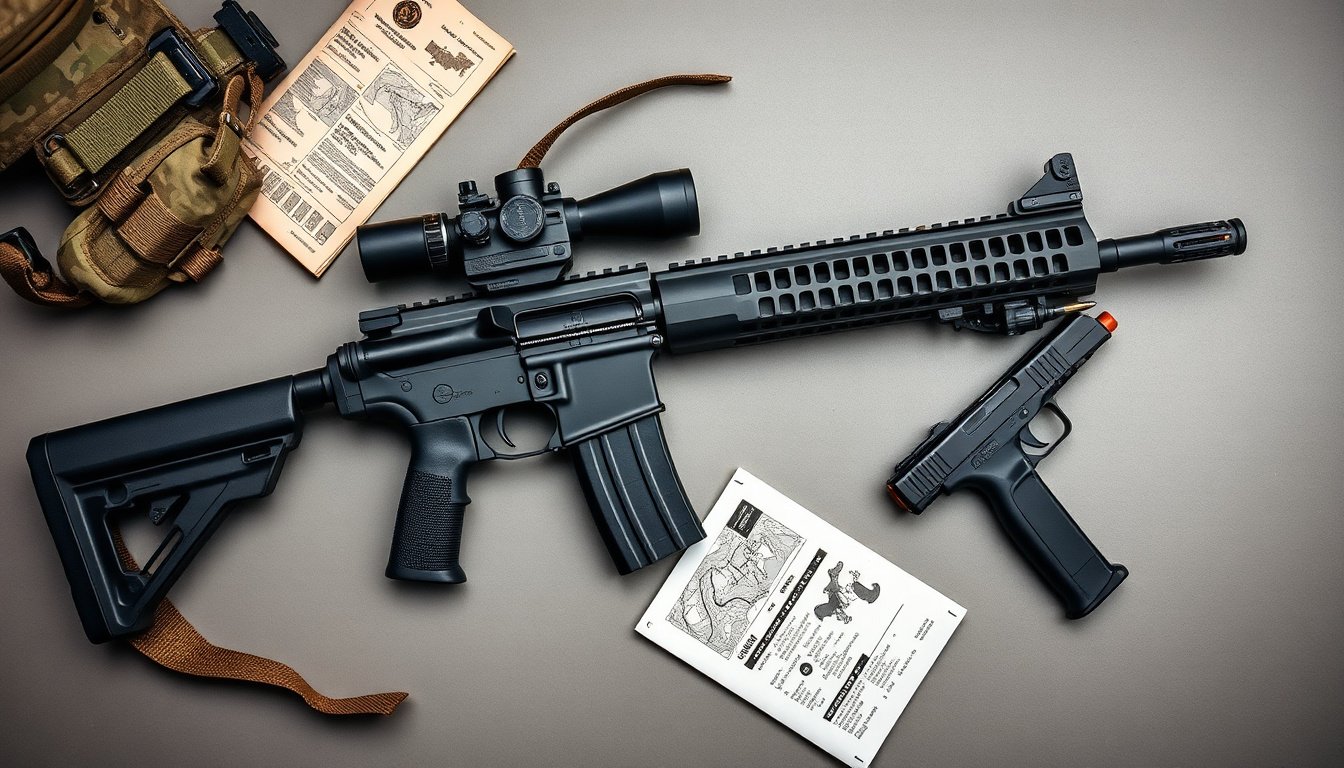
For most readers, this is the center of the answer. The Marine Corps treats the rifle as the core individual weapon, and Marines are expected to be competent with it.
Historically, the M16A4 and M4 carbine have been central Marine rifles. More recently, the M27 Infantry Automatic Rifle has become a common frontline rifle in infantry units, while the M4 still appears in many roles and contexts.
In simple terms, the Marine rifle is the weapon most people picture first. It is the gun Marines train with most often, especially in basic marksmanship and field exercises.
Pro tip: If you are comparing military rifles, focus on the unit’s mission first, because the same service can issue different rifles to different jobs.
For a broader look at how civilian ownership differs from military issue, you may also find our guide on <>how to purchase a gun useful.
Identify the Pistols Marines Use
Not every Marine carries a pistol, but sidearms are important for certain roles. These include officers, military police, security personnel, and some support or special-duty Marines.
The Marine Corps has trained and deployed several pistols in recent years. Commonly referenced models include the M18, the Glock 19 in some roles, and older pistols such as the M9 in historical or limited-use contexts.
Common Marine pistols
- M18 – a compact 9mm pistol used widely across the U.S. military.
- Glock 19 – used in some Marine Corps roles and training contexts.
- M9 – the long-time 9mm service pistol that many people still associate with Marines.
- M45A1 – a.45 ACP pistol used in certain specialized Marine contexts.
Sidearms are secondary weapons. They are there for backup, close-quarters use, or specific duty assignments, not as the main weapon for most Marines.
Recognize Machine Guns and Automatic Weapons
Marines who fill support or squad-automatic roles may use heavier guns that deliver sustained fire. These weapons are not for every Marine, but they are a major part of how Marine units fight.
The most recognizable examples are the M240 machine gun and the M249 squad automatic weapon. In infantry units, the M27 IAR can also serve in a support role depending on how the unit is organized and trained.
These weapons are built for volume of fire, not precision alone. They help a Marine unit suppress threats, control space, and support maneuver.
| Weapon | Typical role | What it does best |
|---|---|---|
| M4 carbine | General issue rifle | Balanced handling for most tasks |
| M27 IAR | Infantry rifle / automatic rifle role | Accuracy with sustained fire capability |
| M18 pistol | Sidearm | Compact backup weapon |
| M240 machine gun | Crew-served support weapon | Sustained fire at longer range |
| M249 SAW | Squad automatic weapon | Mobile suppressive fire |
Support weapons require more training, more ammunition management, and more coordination than a standard rifle. They are a different category of tool, even though people often lump them together as “machine guns.”
When Marine units train with these weapons, the goal is not just to fire them. It is to understand how they fit into the team’s movement and safety procedures.
Look at Shotguns and Special Purpose Guns
Shotguns have a smaller place in Marine service, but they still matter. They are often associated with breaching, security work, and certain military police or guard duties.
In practical terms, shotguns are not the everyday primary weapon for most Marines. They are mission tools, used when their short-range power or specialized purpose makes sense.
Other special-purpose firearms can appear in Marine service too, especially in niche roles. That can include precision rifles, designated marksman rifles, or other weapons tailored to a unit’s mission.
- Shotguns for breaching or close-range security tasks.
- Precision rifles for long-range accuracy.
- Designated marksman rifles for accurate fire beyond standard rifle ranges.
These weapons are less common than the standard rifle, but they show how broad Marine small-arms training can be.
Understand Sniper and Marksman Rifles
Some Marines serve in sniper or designated marksman roles. Those Marines use more specialized rifles than the average rifleman, because their mission is different.
Marine sniper rifles have included models such as the M40 series and the M110 family in various roles and eras. These systems are built for precision and consistency, not the rapid handling of a carbine.
It helps to keep the categories straight: a rifleman’s gun is for broad combat use, while a sniper rifle is for precision at distance. They are both rifles, but they are not used the same way.
If you are interested in the broader military context, the Marine idea of “every Marine is a rifleman” explains why marksmanship training is so central across the Corps.
Know Why the Answer Changes by Job
The biggest mistake is assuming every Marine uses the same gun. In reality, a Marine’s weapon depends on the unit, billet, mission, and training level.
For example, an infantry Marine may train heavily with a service rifle or automatic rifle. A military police Marine may carry a pistol and a carbine. A sniper team will use precision rifles. A support Marine may train on crew-served weapons or only carry a rifle for base defense.
That is also why current weapons can shift over time. The Marine Corps updates equipment as doctrine, contracts, and mission needs change, so the exact lineup can evolve.
Here is a simple way to think about it:
- Most Marines rely on a rifle.
- Some Marines also carry a pistol.
- Specialized Marines use machine guns, shotguns, or precision rifles.
- Exact issue weapons depend on the job and the unit.
If you are trying to understand the buying side of firearms after learning the military basics, a separate guide like <>how to purchase a firearm can help you compare civilian ownership with military use.
Frequently Asked Questions
Do all Marines carry the same gun?
No. The Marine Corps assigns different weapons based on role and mission. Most Marines train around a rifle, but other Marines use pistols, machine guns, shotguns, or precision rifles.
What rifle do Marines use most often?
The answer usually starts with the M4 carbine or the M27 Infantry Automatic Rifle, depending on the unit and assignment. The M16A4 is still part of the Marine story as well, especially in discussions of earlier standard issue.
Do Marines use pistols?
Yes, but not every Marine carries one. Pistols are common in certain jobs such as military police, security, and leadership or support roles.
What is the Marine Corps main weapon?
The main individual weapon is the rifle. The Marine Corps places a strong emphasis on rifle training, because Marines are expected to be effective with their primary shoulder-fired weapon first.
Conclusion
If you were wondering what guns do Marines use, the best answer is that Marines use a family of weapons, not just one gun. The service rifle is the foundation, but pistols, machine guns, shotguns, and precision rifles all have a place depending on the mission.
The exact list changes with the unit and the job, so it is better to think in categories than in a single model name. That gives you a more accurate picture of how the Marine Corps arms its people and why different Marines may carry different weapons.
If you want the most current issue weapons for a specific Marine role, check official Marine Corps information and keep the basic firearm safety rules in mind whenever a gun is handled. Clear role, clear weapon, clear safety is the right way to think about it.